
Review · DOGE'S PALACE TOURS
Immersive Beauty: A Tailored Private Tour of the Doge’s Palace
St. Mark’s Square sets the power scene fast. This private Doge’s Palace tour pairs skip-the-line entry with a guide who connects the rooms to how Venice ruled itself, from marble staircases to justice rooms and the Bridge of Sighs. You start right where the story began, at Caffè Florian in Piazza San Marco, then move through the palace like you have backstage access.
I love how the plan is tailored, not generic. With a licensed guide like Valerio deTourist Venice Valerio Coppo (often mentioned for customizing routes and pacing), you can steer the visit toward what you care about most—history, art, politics, even mythology themes for kids.
My one caution: two hours is tight for this much palace. You’ll see a lot, but you won’t have long, slow “stand and stare” time in every chamber, and Doge’s Palace entrance tickets are not included, so you’ll pay an extra cost on top of the tour price.
In This Review
- Key highlights that matter in real life
- Why the Doge’s Palace feels easier with skip-the-line and a private guide
- Starting at Caffè Florian: the Piazza San Marco orientation that pays off
- Scala dei Giganti: where the power imagery starts
- Loggia and views: the palace’s balcony moment
- Scala d’Oro: opulence with a point
- Atrio Quadrato and Sala delle Quattro Porte: the palace as a workplace
- Anticollegio, Collegio, and the Senate: follow the decision-making chain
- Council of Ten and the Compass Room: justice with a shadow
- Armoury and legal rooms: military strength and civil justice
- The Scrutinio and Quadreria: how voting becomes theatre, then art ends the story
- Bridge of Sighs and the New Prisons: the payoff and the mood shift
- How long it really feels: 2 hours, 20 stops, and how to get the most
- Price and value: what $185.43 per person buys you
- Who this tour suits best
- Should you book this Doge’s Palace private tour
- FAQ
- Where does the tour start?
- How long is the private tour?
- Is this tour private?
- Are Doge’s Palace entrance tickets included?
- Do you get skip-the-line or fast-track entry?
- What language is the tour offered in?
- Which major sites inside the experience are included?
- Can I bring a service animal?
- Is free cancellation available?
Key highlights that matter in real life
- Fast-track entry helps you beat the worst lines right when the day is busiest.
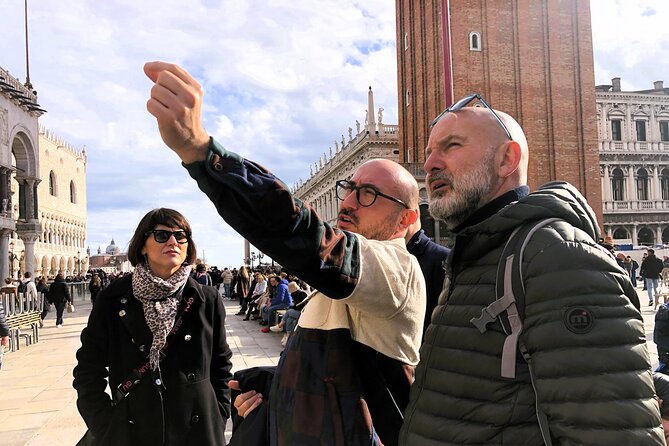
- You get a guided route that reaches key rooms without feeling like you’re wandering on your own.
- The tour is tailored to your interests, so the guide can spend more time where you lean in.
- You see the palace’s political machine, justice system, and military room—not just pretty halls.
- The visit includes the Bridge of Sighs and the New Prisons, adding a darker payoff.
Why the Doge’s Palace feels easier with skip-the-line and a private guide
Venice’s Doge’s Palace is one of those places where the building is the “text,” and a good guide is the “translator.” Without help, it’s easy to drift from stair to room and lose the thread of what each space was for. With a private guide, you get that thread—fast—and you don’t waste time figuring out where to go next.
The tour is private, so it’s just your group. That matters here, because the palace is a maze of staircases, corridors, and doorways, and group speed can make or break your experience. A private pace also helps you actually look: carved symbols on staircases, artwork in councils’ rooms, and the geometry of the palace spaces.
The skip-the-line angle is also practical. This is a high-demand site, and if you arrive at the wrong moment, you can lose the best part of the day waiting. Starting from Piazza San Marco also helps your timing because you’re already in the core tourist zone—no long transit, no extra confusion.
More time inside the Doge's Palace, compared
- Venice: Doge’s Palace Reserved Entry Ticket★ 4.6 · 42,716 reviews
- Doge’s Palace & St. Mark’s Basilica with Terrace Access Tour★ 4.7 · 10,697 reviews
- Venice: Doge’s Palace and St Mark’s Basilica Walking Tour★ 4.4 · 6,291 reviews
- Legendary Venice: Doge’s Palace, St Mark’s & VIP Terrace Access★ 4.5 · 5,033 reviews
Starting at Caffè Florian: the Piazza San Marco orientation that pays off
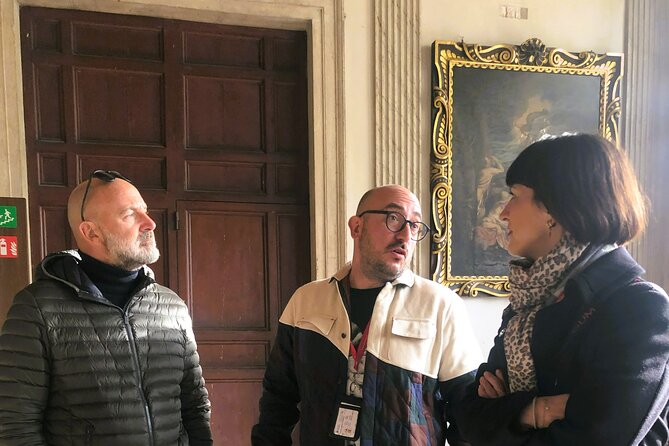
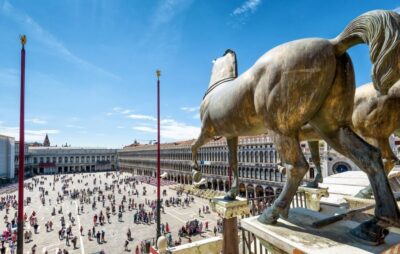
The meeting point is Caffè Florian, Piazza San Marco 57. That’s a smart pick, because you immediately get your bearings in the right square instead of trekking across town looking for your guide. You’ll also feel the scale of St. Mark’s Square from the start—open space, major facades, and that classic Venice sense of “everything important happens in public.”
Stop one is Piazza San Marco, where your guide sets context. Instead of starting inside the palace with random facts, you get the big picture: how the square developed, what it was used for, and why St. Mark’s became the stage for Venice’s power and ceremonies. It’s the kind of setup that makes later rooms click.
The downside? If you’re already exhausted by Venice crowds in the square, you’ll want to keep moving. This stop is short—around five minutes—so it’s meant as a quick orientation, not a long walking tour of every corner.
Scala dei Giganti: where the power imagery starts
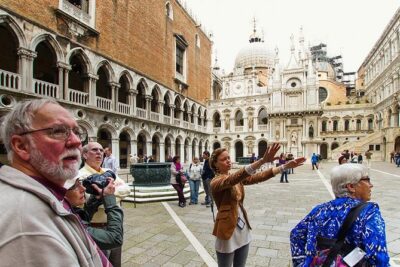
Next up: Scala dei Giganti di Palazzo Ducale, the imposing staircase that greets you with symbolism. This isn’t just a pretty climb. Your guide points out the sculptures and the visual language of authority—how Venetian rulers projected control through architecture.
The best part here is how fast the building starts telling you what it thinks of you. You’re not just touring rooms; you’re reading messages carved into stone: who mattered, what decisions were made, and how public power looked from the outside.
A practical note: stairs in Venice are normal, but you’ll still want comfortable shoes. The tour’s rhythm is steady. You’ll move through multiple key spaces quickly, and the stairs and corridors add up.
Loggia and views: the palace’s balcony moment
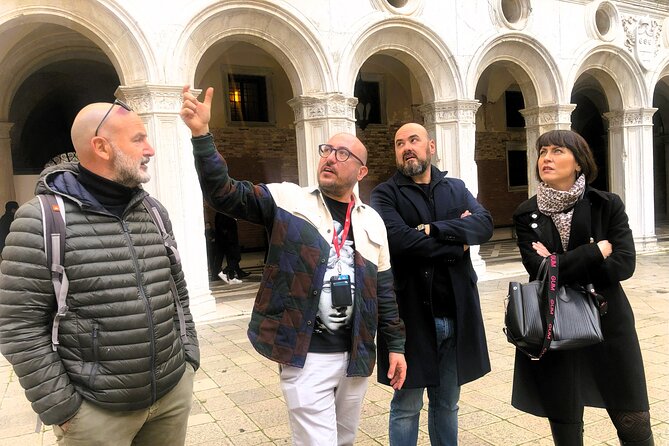
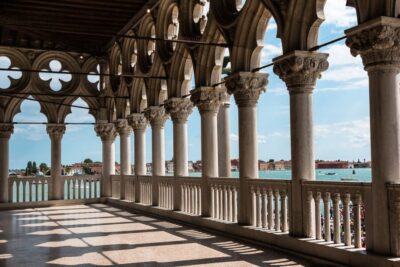
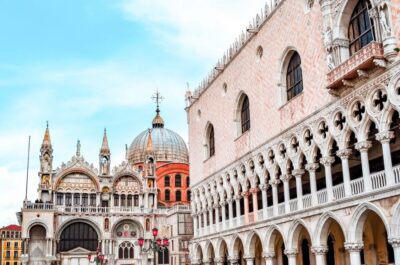
You then step into the Loggia, described as an open gallery with arches and views over St. Mark’s Basilica and the square below. This is a good reset moment. You go from symbolic stairways to a live view of Venice in action—people below, architecture framing the scene, and your guide tying it back to public life.
Don’t treat this as a photo-only stop. The value is in the explanation of why this architectural “in-between” space mattered. Venice was intensely visual; rulers didn’t hide. They operated where people could see them, and rooms like this helped the palace connect to the city’s daily rhythm.
Scala d’Oro: opulence with a point
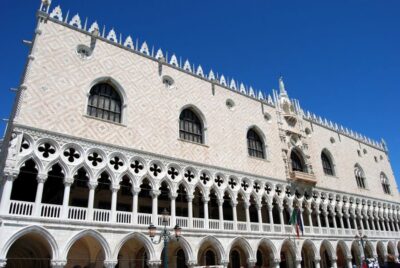
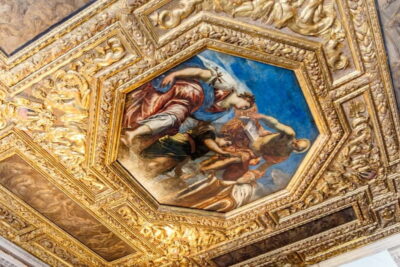
Then comes the Scala d’Oro (Golden Staircase). The name isn’t subtle. This is where the palace puts its prestige on full display—wealth, status, and the theatrical side of governance.
Your guide usually frames it as more than decoration. The goal is to connect the artistic choices to the office’s identity: who used this space, what it represented, and how Venice’s elite communicated rank through art and design.
If you’re short on time in Venice (most people are), this is one of the spots where a guide helps most. You don’t want to just walk past the staircase; you want to understand why it’s “special” in a political sense, not only an aesthetic one.
More just-your-group bookings

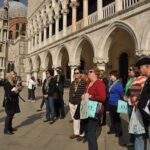


Atrio Quadrato and Sala delle Quattro Porte: the palace as a workplace
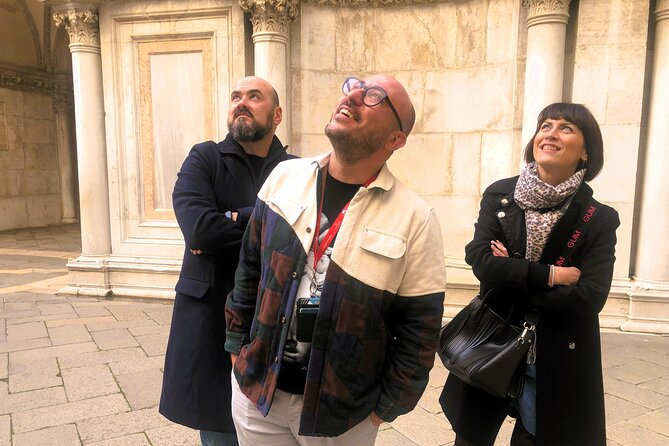
Inside, the tour moves into spaces that feel less like a museum lobby and more like an operating system.
- Atrio Quadrato (Square Atrium): you’ll learn the purpose of this space and how it fit into daily life inside the Doge’s Palace. Think of it as the palace’s internal “breathing room,” where movement and function matter.
- Sala delle Quattro Porte (Four Doors Room): this is where politics and negotiation become concrete. Your guide focuses on the room’s political history and the choices made there, plus the details in the artwork and design.
What I like about this segment: it’s not only about “what happened.” It’s also about how the building shaped behavior. Doorways, flow, and visibility all influenced how people worked.
The consideration: if you’re very art-focused, you might want a longer pause. The tour keeps moving. You’ll see the highlights, but you’ll have to pick your spots if you want extra time staring at every corner.
Anticollegio, Collegio, and the Senate: follow the decision-making chain
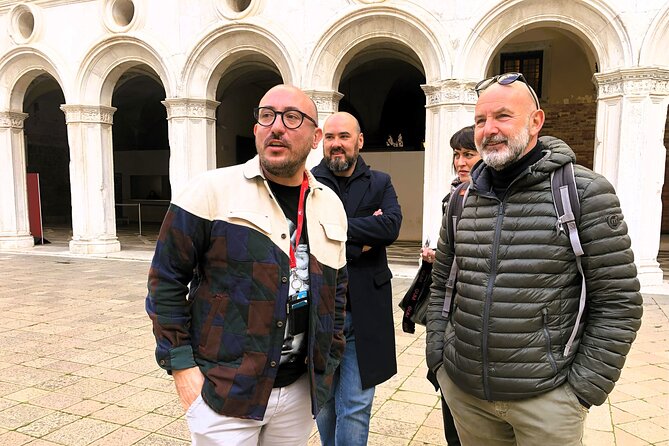
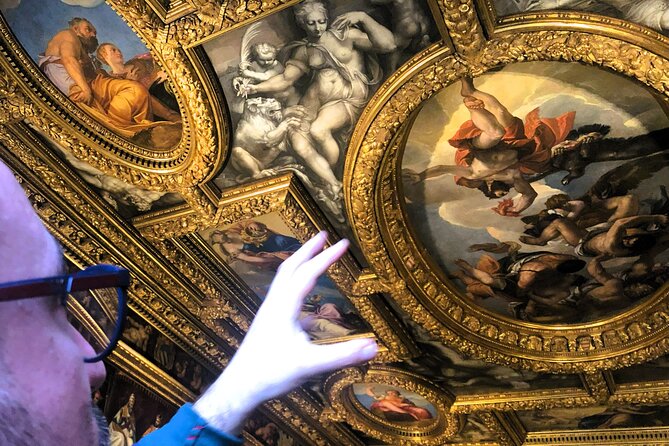
Next is the heart of political drama, starting with the Sala dell’Anticollegio. This antechamber includes masterpieces by artists such as Tintoretto and Veronese, which gives the guide a chance to connect art to the culture of the Republic—art wasn’t separate from politics; it was part of how power looked and felt.
From there you move through the council rooms:
- Sala del Collegio (Council Chamber): described as the center of decision-making in Venice, where your guide explains how political drama shaped the city’s destiny.
- Senato (Senate): where senators met to discuss matters of state, plus context on Venice’s political structure.
This is where a guided explanation really pays off. A building like this can look overwhelming, but the palace has a logic: different bodies, different responsibilities, different rooms that represent roles in governance. With a good guide, you leave understanding what each council did—even if you only skim the surface of the Republic’s system.
Council of Ten and the Compass Room: justice with a shadow
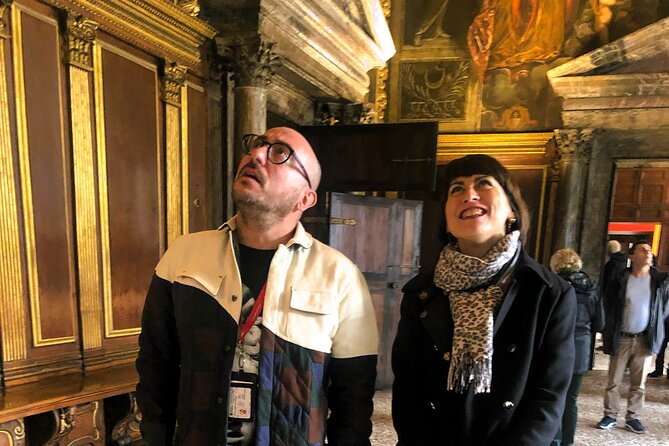
Then you reach rooms tied to control and enforcement.
- Consiglio dei Dieci (Council of Ten): your guide frames this council as dedicated to maintaining stability and order. You’ll get the idea that Venice didn’t just make laws; it built institutions to protect them.
- Sala della Bussola (Compass Room): one of the most intriguing stops. It’s linked to justice and espionage through the small window where anonymous accusations were submitted. Your guide explains the system of secret denunciations and how it helped the state preserve itself.
This segment can feel unsettling in a good way. It’s not crime-story sensationalism; it’s about mechanisms—how a government gathers information and responds. If you like political systems, this is the moment you’ll start connecting Venice’s art and architecture to something practical: governance, surveillance, and accountability (as the Republic defined it).
The drawback? The topic is heavy, and the pace is still fast. If your group is sensitive to darker themes, you can ask the guide to slow down, especially here.
Armoury and legal rooms: military strength and civil justice
Next comes Armeria (Armoury), which your guide uses to explain the maritime defense of the Venetian Republic. Venice was built on sea power, and the armory helps make that real.
Then you visit Sala della Quarantia Civil Vecchia (Chamber of Quarantia Civil Vecchia), tied to Venice’s justice system and legal framework. This is one of those stops where the guide turns a room of art and symbolism into a lesson about how society tried to stay ordered.
After that, you’ll see Sala del Guariento, a room featuring artwork connected to the Republic’s golden age, followed by Sala del Maggior Consiglio (Chamber of the Great Council)—described as the largest chamber in the palace and home to major assemblies.
This stretch works best if you want both the “human” side and the “institution” side. The palace isn’t only about rulers in robes; it also contains the rooms where decisions affected ordinary people.
The Scrutinio and Quadreria: how voting becomes theatre, then art ends the story
Next is Sala dello Scrutinio (Chamber of Scrutionio). Your guide explains elections, voting processes, and the Venetian electoral system. It’s fascinating because it shows how the Republic handled legitimacy and selection through structured procedures.
Then you move to Quadreria (Picture Gallery). This art collection rounds out the tour by returning to beauty, but in a purposeful way. You’ll understand how artworks reflected Venetian culture and how art “performed” the identity of the state.
A quick tip: if you’re the type who gets tired walking through indoor galleries, this is the last interior anchor before the palace ends. Pace yourself so you still enjoy the art instead of just collecting rooms as checkmarks.
Bridge of Sighs and the New Prisons: the payoff and the mood shift
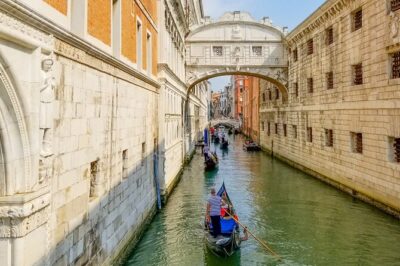
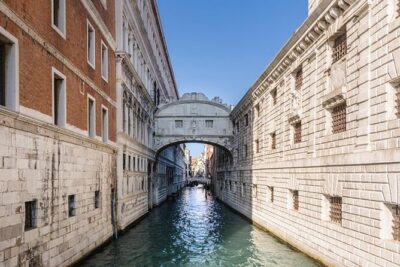
You then cross the Ponte dei Sospiri (Bridge of Sighs). This is the iconic moment, with stories about the prisoners who crossed it. Your guide separates legend from reality in a way that keeps it grounded. Even if you’ve seen photos, the experience hits harder in person because the bridge sits in the palace’s justice pathway.
Finally, you visit Palazzo Delle Prigioni Nuove (New Prisons). This is the darker turn: the judicial process, the prison system, and the people caught in it. It’s not a gory walkthrough; it’s a historical explanation of how the Republic handled punishment and custody.
If you want a Venice day that includes both political beauty and real consequences, this ending is exactly how you want it to finish.
How long it really feels: 2 hours, 20 stops, and how to get the most
The tour runs about 2 hours and includes a long list of palace rooms and corridors. Each stop is short, often around five minutes, with a couple longer segments for the Bridge of Sighs and the New Prisons.
So here’s the reality: you’re getting highlights plus context, not a slow, lingering museum visit. That’s not bad. It’s a smart way to see the structure of the palace and understand what matters. But it does mean you should pick your priorities.
If your top interest is art, you might want extra attention at the rooms with major paintings (like the Anticollegio with artists named above) and at the picture gallery. If your interest is governance, concentrate on the council rooms and the Council of Ten, then let the Bridge of Sighs and prisons do the emotional close.
Price and value: what $185.43 per person buys you
The price is $185.43 per person for a private tour in English, lasting around two hours. What you’re paying for isn’t only a guide standing next to you. You’re buying:
- a licensed guide
- fast-track entry to reduce waiting
- assistance purchasing skip-the-line tickets at a best-possible rate
- customization so the visit matches your interests
- a route that hits the palace’s key political and justice spaces rather than repeating the same surface stops
The important catch is that Doge’s Palace entrance tickets are not included. So your total cost depends on the additional entry fee for the palace. Still, even with that extra expense, the value is usually strongest for first-time visitors or anyone who doesn’t want to lose time figuring out the palace layout.
One more value angle: Venice is crowded. A guide helps you avoid the “lost in lines and corridors” pattern, and that time saved can be worth more than the difference between a self-guided visit and a supported one.
Who this tour suits best
This works especially well if you:
- want a first serious look at the political and legal world of the Venetian Republic
- care about how architecture and art connect to power
- prefer a planned route instead of wandering in the palace
- are traveling with kids and want the guide to adjust explanations (one family experience highlighted tailoring between children and adults, with interests like Greek and Roman mythology)
If you want total quiet and long pauses in every room, you may find the pace a bit brisk. In that case, you might be happier with a longer, more leisurely visit format.
Should you book this Doge’s Palace private tour
Book it if you want to leave with a clear understanding of how Venice ran itself: councils, justice, military strength, and the prison system, all inside one of the most dramatic buildings in Europe. The skip-the-line start, private pacing, and tailored guidance are what make this feel efficient and satisfying, not rushed.
Skip it or consider another format if you only want quick postcard photos or if your group plans to spend long stretches on each floor without guidance. Also factor in the fact that palace entrance tickets are extra, so check your total budget before you commit.
If you want one high-impact Venice experience that helps you read the palace instead of just passing through it, this is a strong pick.
FAQ
Where does the tour start?
It starts at Caffè Florian, Piazza San Marco 57, 30124 Venezia VE, Italy.
How long is the private tour?
The tour lasts about 2 hours.
Is this tour private?
Yes. It is a private tour/activity, and only your group participates.
Are Doge’s Palace entrance tickets included?
No. Entrance tickets to the Doge’s Palace are not included. You may need special fares depending on your situation.
Do you get skip-the-line or fast-track entry?
Yes. The experience includes fast-track entry, and the provider also assists with purchasing skip-the-line tickets at the best possible rate.
What language is the tour offered in?
The tour is offered in English.
Which major sites inside the experience are included?
You visit key areas of the Doge’s Palace, cross the Ponte dei Sospiri (Bridge of Sighs), and explore the New Prisons.
Can I bring a service animal?
Yes. Service animals are allowed.
Is free cancellation available?
Yes, you can cancel for free up to 24 hours in advance for a full refund.
More Tours in Venice
- Murano & Burano: Boat Tour with Guide & Glass Factory Visit
★ 4.3 · 10,716 reviews - Doge’s Palace & St. Mark’s Basilica with Terrace Access Tour
★ 4.7 · 10,697 reviews - Venice: Burano, Torcello & Murano Boat Tour w/Glassblowing
★ 4.4 · 10,245 reviews - Murano, Burano and Torcello Half-Day Sightseeing Tour
★ 3.5 · 7,928 reviews - Murano & Burano Islands Guided Small-Group Tour by Private Boat
★ 4.5 · 7,580 reviews - Venice: Doge’s Palace and St Mark’s Basilica Walking Tour
★ 4.4 · 6,291 reviews
More Tour Reviews in Venice
- Venice: Doge’s Palace Reserved Entry Ticket
★ 4.6 · 42,716 reviews - Venice: Grand Canal Gondola Ride with App Commentary
★ 4.1 · 23,020 reviews - Venice: Grand Canal Gondola Experience with Live Commentary™
★ 4.2 · 16,504 reviews - Boat Trip: Glimpse of Murano, Torcello & Burano Islands
★ 4.3 · 15,699 reviews - Venice: La Fenice Opera House Entry Ticket with Audio Guide
★ 4.6 · 11,742 reviews - Murano & Burano: Boat Tour with Guide & Glass Factory Visit
★ 4.3 · 10,716 reviews
Inside the Doge's Palace, a Few More Ways
- Venice: Doge’s Palace Reserved Entry Ticket
★ 4.6 · 42,716 reviews - Doge’s Palace & St. Mark’s Basilica with Terrace Access Tour
★ 4.7 · 10,697 reviews - Venice: Doge’s Palace and St Mark’s Basilica Walking Tour
★ 4.4 · 6,291 reviews - Legendary Venice: Doge’s Palace, St Mark’s & VIP Terrace Access
★ 4.5 · 5,033 reviews - Venice: Doge’s Palace and St. Mark’s Basilica Tour
★ 4.5 · 3,734 reviews - Venice In a Day: St Mark’s, Doges Palace Gondola Ride & City Tour
★ 5.0 · 3,588 reviews
Fresh Off the Vaporetto: New Venice Reviews
Doge's Palace Tours, compared.
 ★ 4.6Doge’s Palace Reserved Entry TicketFrom $4142,716 reviews
 ★ 4.7Doge’s Palace & St. Mark’s Basilica with Terrace Access TourFrom $12310,697 reviews
 ★ 4.4Doge’s Palace and St Mark’s Basilica Walking TourFrom $1016,291 reviews
 ★ 4.5Legendary Venice: Doge’s Palace, St Mark’s & VIP Terrace AccessFrom $765,033 reviews
 ★ 4.5Doge’s Palace and St. Mark’s Basilica TourFrom $1083,734 reviews
 ★ 5.0Venice In a Day: St Mark’s, Doges Palace Gondola Ride & City TourFrom $1243,588 reviews
 ★ 4.7St. Mark’s Basilica & Doge’s Palace Tour with TicketFrom $943,375 reviews
 ★ 4.5St Mark’s Basilica, Doge Palace, & Bell Tower OptionFrom $1002,633 reviews
Browse the lists this tour appears in