
Review · HIDDEN & SECRET VENICE TOURS
Secrets of Venice Carnival and Life of Casanova Tour
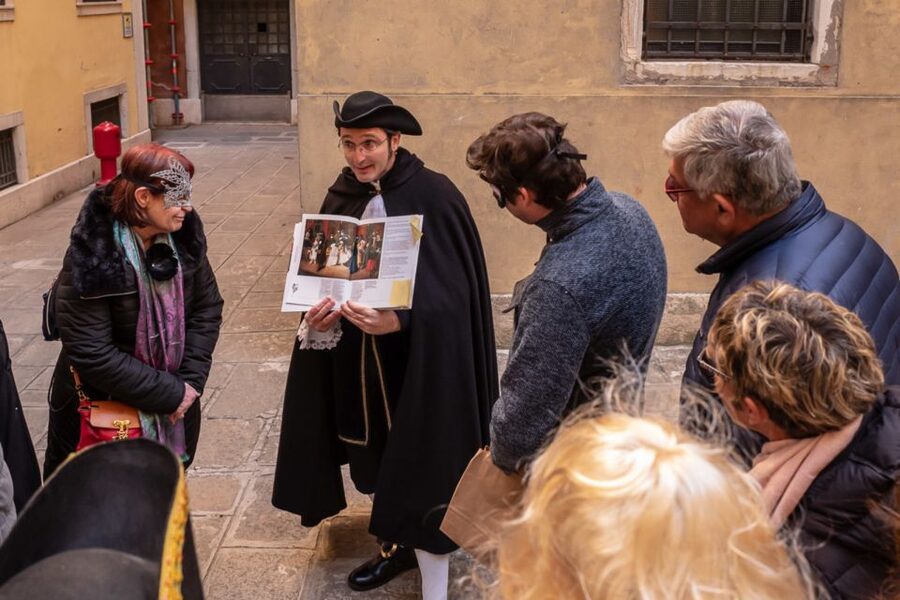
Casanova and Carnival in the same walk. This 2-hour Venice tour ties together Giacomo Casanova’s life, the story behind Venetian masks, and the look of 17th- and 18th-century celebration, with a warm stop for a hot cappuccino and Carnival frittella at the end. What I like most is the mix of smart street history plus practical storytelling in the alleys, and the way the guide brings the era to life with Carnival-style costuming. The main thing to consider is the typical downside of Venice walking tours: rain, crowds, and standing time can make it harder to hear in the narrow streets, especially with larger groups.
You meet at Teatro la Fenice and spend your time moving through smaller streets rather than hovering at only the biggest photo spots. It’s the sort of tour that helps you connect names like Casanova and poets like Giorgio Baffo to real places you can point at. And because the tour ends in a café about a 10-minute walk from St Mark’s Square, it also works well as a strong start to your Carnival-day plans.
In This Review
- Key things you’ll notice on this Casanova & Carnival walk
- Arriving at Teatro la Fenice: where Carnival energy starts
- Casanova’s Venice: San Samuele calle after calle
- Masks explained: secrecy, status, and the craft behind them
- A Ridotto look at Venetian nightlife and aristocracy
- Palazzo Contarini del Bovolo: 17th-century style in the flesh
- Campo Santo Stefano and the poet connection that shapes Casanova
- Ending at Le Café Venezia: frittelle and cappuccino, properly warm
- Cost and value: what $88 buys you in real terms
- Group size, rain, and staying together: the one real caution
- Is this tour right for you? Best fit and best skip
- Should you book this Casanova & Carnival tour?
- FAQ
- Where is the meeting point?
- How long is the tour?
- What’s included at the end?
- Can I wear a Carnival costume?
- Is the tour wheelchair accessible?
- Is the tour guide English-speaking, and is free cancellation available?
Key things you’ll notice on this Casanova & Carnival walk
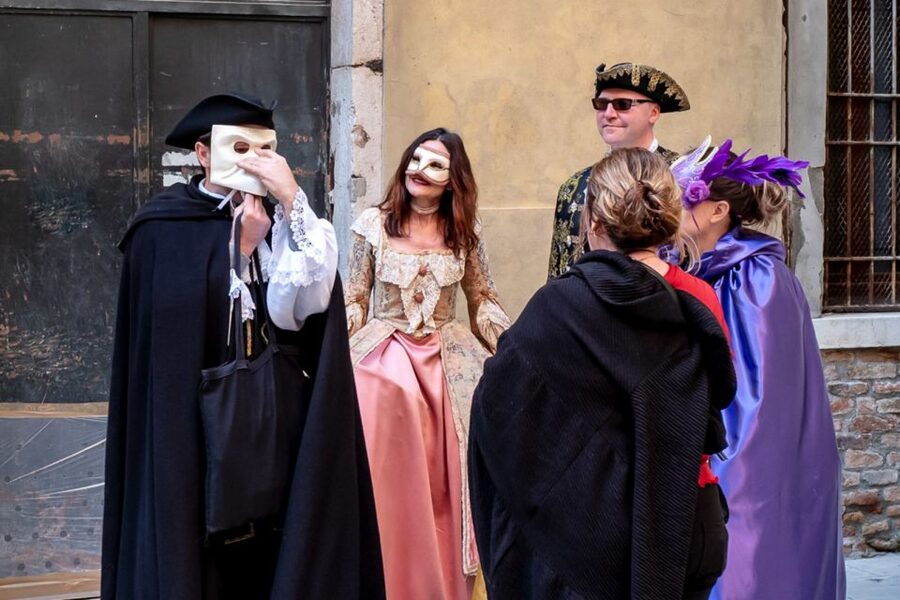
- Costumed guide at Teatro la Fenice sets the tone fast, right where Venice’s theatrical side feels real
- Mask history and mask-making explains why Carnival masks mattered beyond the looks
- Backstreet route through Casanova’s Venice connects San Samuele to the city’s social life
- Ridotto and courtly entertainment gives context for the parties and aristocracy Casanova navigated
- 17th-century flamboyant costumes show how style, secrecy, and status played together
- Cappuccino + Carnival frittella turns the tour into a proper Venetian break, not just a stroll ending
Arriving at Teatro la Fenice: where Carnival energy starts
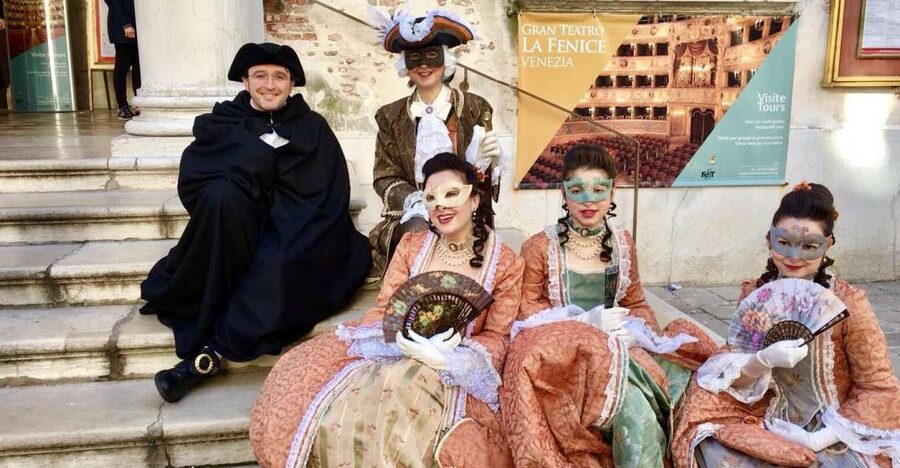
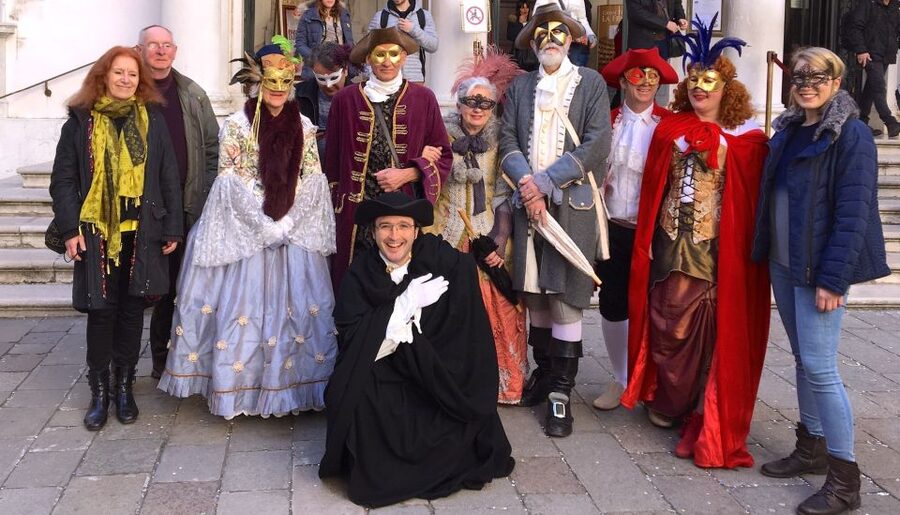
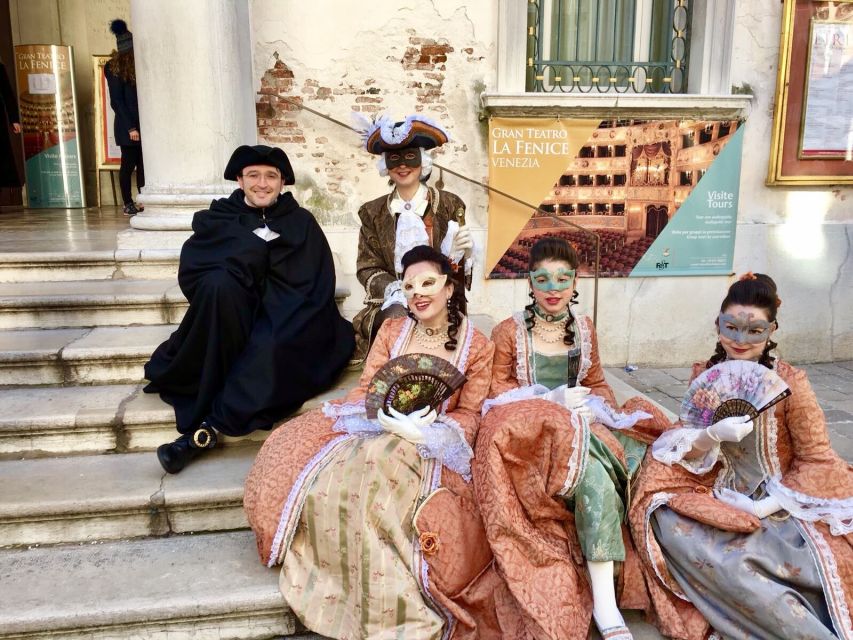
Your tour begins at Teatro la Fenice, with the meeting point at Campo della Fenice in front of the opera house. Expect to spot your guide holding a sign with the tour name, and often dressed in traditional Carnival costume to get you into the mood right away. This matters because Venice feels like a stage during Carnival, and starting at a major landmark anchors the whole walk.
From there, you’re not just “walking around Venice.” The plan is to set up a story—Casanova first, then Carnival customs—so each turn down a calle (alley) has a reason. If you’re the kind of traveler who likes your sightseeing to come with names, dates, and a sense of cause-and-effect, you’ll feel at home.
Off the main drag: quieter Venice, a few more ways
- Tour of The Real Hidden Venice★ 5.0 · 2,006 reviews
- Venice: Off the Beaten Path Private Gondola Ride★ 4.3 · 703 reviews
- Venice: Doge’s Palace Prisons & Secret Itineraries Guided Tour★ 4.5 · 665 reviews
- Secret Venice & Gondola Tour★ 4.3 · 458 reviews
Casanova’s Venice: San Samuele calle after calle
One of the strengths of this tour is how it treats Casanova like a person living inside the city, not a museum figure. The walk follows the areas tied to Casanova’s early life, including the San Samuele district, which the tour connects to where he grew up. As you move through narrow calle, the guide’s job is to make the maze feel navigable by giving it a storyline.
You’ll also pass locations linked to key players in his world. The tour includes a stop conceptually tied to Casanova’s home area, and it also references the poet Giorgio Baffo, who introduced the young Casanova to worldly pleasures. The point isn’t to turn Venice into a “Great Lovers” myth. It’s to show how social life, literature, and entertainment fed each other in 18th-century Venice.
And yes, it’s a walking tour, so you’ll want comfortable shoes. Venice is famous for beauty; it’s also famous for foot fatigue. This is the part where you’ll appreciate having a guide steering you so you don’t spend the morning trying to map out history on your own.
Masks explained: secrecy, status, and the craft behind them
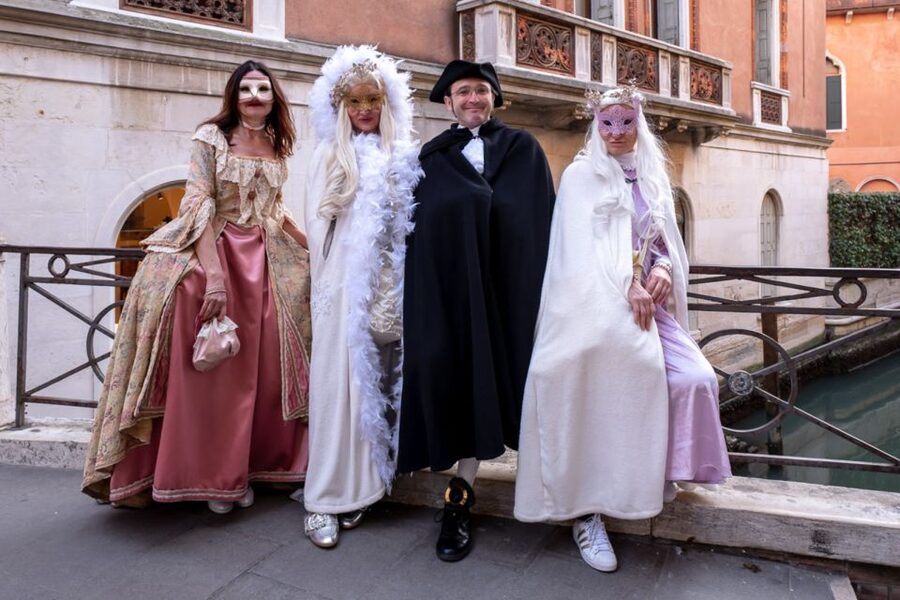
Carnival masks sound simple until someone explains what they were for. Here, you’ll learn how traditional masks were used to hide the wearer’s identity, and why that mattered in a city where reputation could make or break you. That context is useful today, because it changes how you interpret what you see in the streets during Carnival.
You’ll also hear about the history of the masks and how they’re made. The craft details are where this tour gets especially hands-on in spirit. Even if you’re not studying artisan techniques, it helps you see masks as objects with purpose—style with a job—not just costumes for photos.
If you’re taking photos, this is the sweet spot. Masks look best when you understand them, and you’ll have more to say in your captions than just Venice in disguise.
A Ridotto look at Venetian nightlife and aristocracy
Midway through the story, the tour shifts to how Venice structured entertainment. You’ll hear about the Ridotto, described as the first casino in Venice, where Casanova would meet the Venetian aristocracy. That single detail changes the whole tone of the Carnival talk. It’s not only about street fun—it’s about social spaces with rules, access, and a clear hierarchy.
The guide also weaves in stories tied to courtesans, who played a role in making the city’s social scene as lively as possible. This is the part where you start to see Venice’s nightlife as a system: people, venues, performance, and gossip all working together.
For me, the value here is that it gives you context for what you’ll see later—private palaces hosting grand balls, people dressed to the nines, and a Carnival mood that feels more organized (and more intense) than it looks from the outside.
Palazzo Contarini del Bovolo: 17th-century style in the flesh
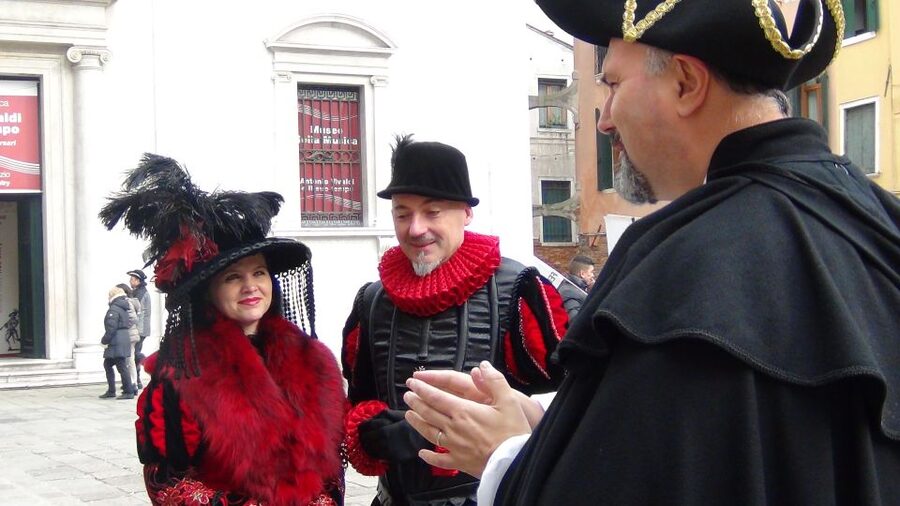
The walk includes a stop by Palazzo Contarini del Bovolo, and this is where the “look” of Carnival becomes more specific. The tour talks about flamboyant 17th-century costumes and connects them to the idea of people dressing up not just to be seen, but to parade their status through the streets. You get a sense of how costume functioned like a language.
If you like architecture and fashion together, you’ll likely enjoy this segment. Even without going inside every building, the area gives you a sense of scale and historical texture, and the guide’s storytelling helps it connect to the people who would have moved through these spaces.
One small practical thought: Venice weather can be unpredictable in Carnival season. If it’s cold or rainy, this is the part where you’ll wish you had a layer under your cape or costume so you can stand comfortably while listening.


Campo Santo Stefano and the poet connection that shapes Casanova
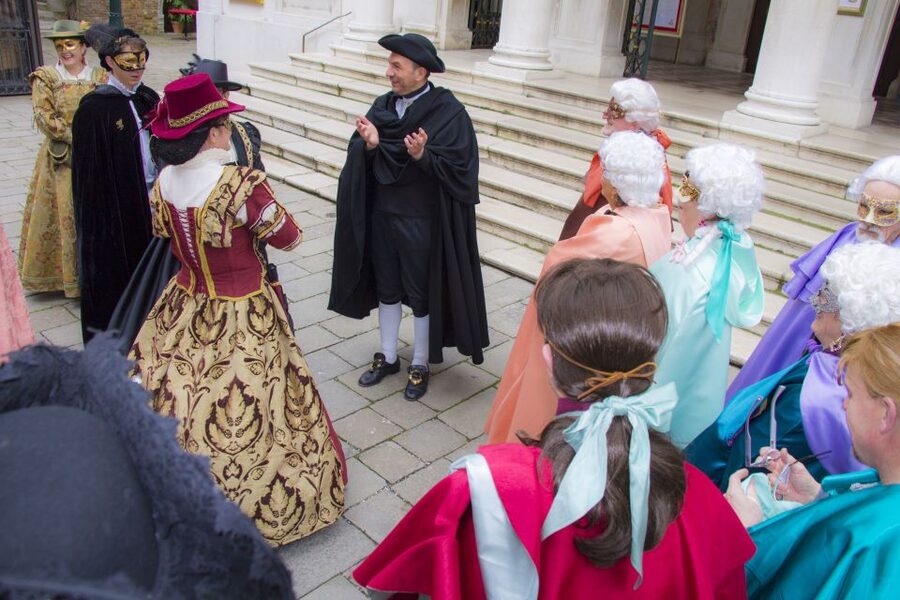
Another key stop is Campo Santo Stefano, where the tour continues by linking Casanova’s life to the people who shaped his ambitions and tastes. The connection to Giorgio Baffo—introduced as the poet who brought Casanova to worldly pleasures—adds a literary angle that makes the story feel broader than romance alone.
You’ll also hear about the broader Carnival traditions and how they connect to everyday Venice. That matters because Carnival isn’t a separate universe. It’s a spotlight put on Venetian life, with masks and costume changing the social rules for a short season.
This segment is also a good time to slow down and watch other people. As the guide talks, you can start to read the streets the way the tour does: who’s dressed elaborately, who’s staying playful, who’s treating it like performance, and who’s using anonymity to roam.
Ending at Le Café Venezia: frittelle and cappuccino, properly warm
The tour finishes at Le Café Venezia, about a 10-minute walk from St Mark’s Square. This is a smart ending, because it gives you a clear “done” moment and a place to reset before the rest of your day.
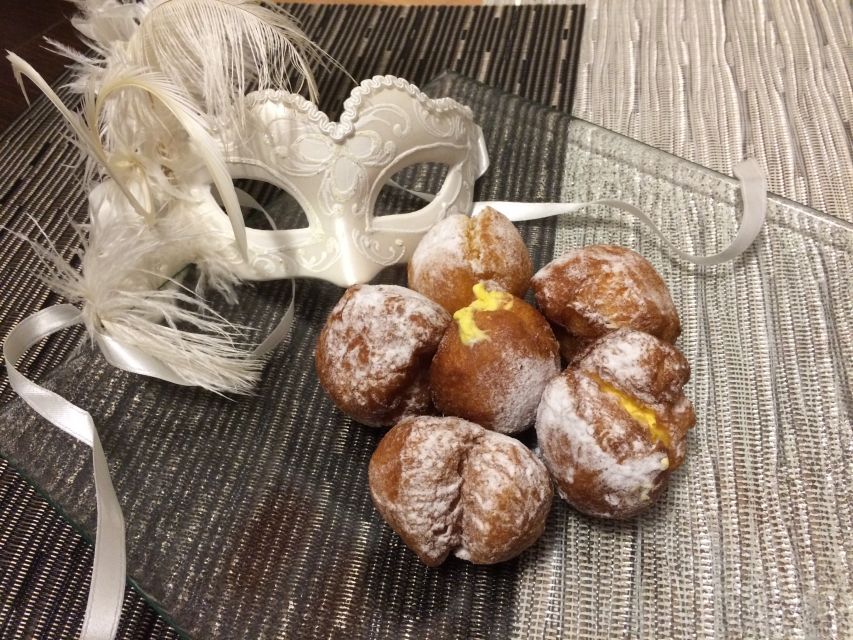
You’ll get a hot cappuccino and a Venetian Carnival cake called frittelle. The tour notes that frittelle are only made during Carnival, and that makes the food feel tied to the season instead of being a random sugar stop. If you’ve walked around Venice hungry, you’ll appreciate that timing.
One practical advantage: finishing in a café lets you dry out a bit if the weather turned. It’s also where you can ask questions after the walk if something sparked your interest—Casanova’s side of Venice, mask craft, or why the Ridotto mattered so much.
Cost and value: what $88 buys you in real terms
At $88 per person for a roughly 2-hour experience, the value depends on what you want from Venice. If you’re paying for a guide, storytelling, and a seasonal food stop, the price starts to make sense. You’re not just buying “a route,” you’re buying context: Casanova’s life mapped onto actual streets, plus explanations of Carnival masks and traditions that you can’t easily piece together from guidebooks alone.
The included cappuccino and frittelle also matter. In Venice, buying one warm drink and a snack can cost you enough that it’s not a trivial add-on. Here, it’s part of the tour design: you finish your walking with something warm and local, at a set location rather than hoping you’ll find the right place afterward.
There’s also the “how” factor: your guide is typically dressed in Carnival costume, and multiple reviews mention guides like Sergio (often called Sergio aka The Swiss) and Dennis. When the guide is fun and consistent, the tour feels like an evening story you’re walking through—not a lecture that ends with dessert.
Group size, rain, and staying together: the one real caution
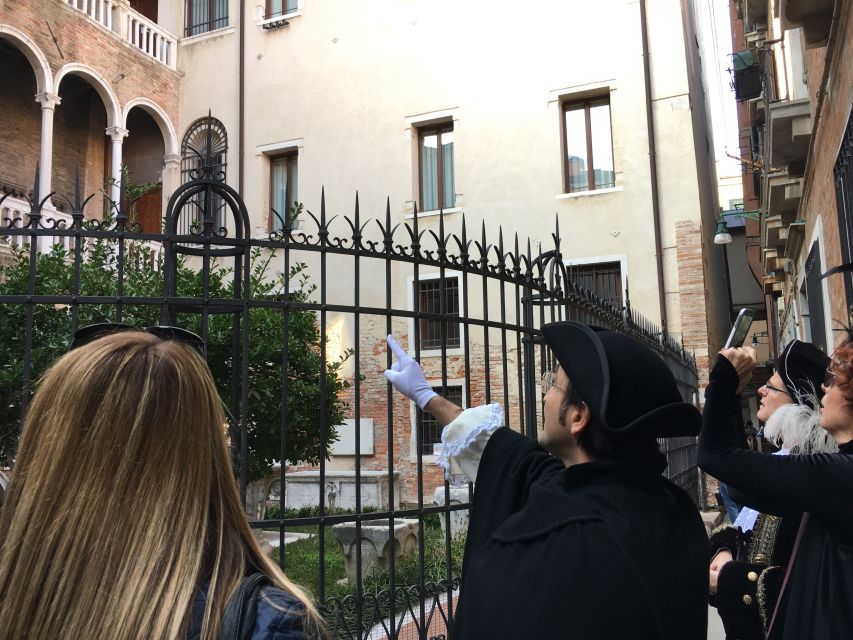
The biggest potential drawback is noise and crowding in Venice streets during peak season. One review pointed out that rain and busy areas made it hard to hear, and that the group size could make the experience feel harder than it should. Another comment said some stops felt too long standing, which is worth remembering if your legs are sensitive to long pauses.
There’s also a basic group-management concern: on at least one occasion, a guest said they were left behind somewhere else in Venice. That’s not something you should expect, but it’s a reminder to stay close—especially at crossings and when the guide checks in on the group.
Your best defense is simple:
- Keep your phone charged and watch the guide’s hand signals.
- Wear footwear you can stand in for stretches.
- If it’s raining, protect your ears as much as your clothes. A small umbrella plus thicker outerwear can help you stay comfortable and attentive.
Is this tour right for you? Best fit and best skip
This tour is a great match if you like:
- Venice Carnival as culture, not only costumes
- history told through real neighborhoods (like San Samuele)
- Casanova as a gateway character into social life, secrecy, and entertainment
- a guide who can balance story and humor, since reviews specifically highlight charming, funny guiding styles
It may not be ideal if you:
- need wheelchair access (the tour is not suitable for wheelchair users)
- want a mostly seated experience (this is a walking-and-standing format)
- dislike crowds and narrow alleys, especially in rainy weather
Also note the practical rule about luggage: oversize luggage isn’t allowed. If you’re rolling bags, plan for that before the meeting time.
Should you book this Casanova & Carnival tour?
Yes, I’d book it if you want a Venice Carnival experience with actual context—masks that had a purpose, a nightlife scene shaped by places like the Ridotto, and street history tied to Casanova and the poet Giorgio Baffo. The included cappuccino and Carnival frittelle make it feel like more than a sightseeing checkbox.
I’d think twice only if you know you struggle with hearing over rain and crowd noise, or if large groups make you anxious. In those cases, you’ll enjoy it more if you arrive prepared to stand comfortably and you stay close to the guide at every turn.
FAQ
Where is the meeting point?
You meet at Campo della Fenice, in front of Teatro la Fenice. If you’re coming from St Mark’s Square, the route described is to pass under the arches close to the Correr museum, take the salisaza San Moisè, continue along, cross the bridge in front of the hotel Bauer onto Calle Larga XXII Marzo, turn second right onto Calle della Vesta, cross the small bridge, and the well in Campo della Fenice should be about 50 yards ahead. Look for the guide with the tour sign.
How long is the tour?
The tour is listed as 2 hours in total, and the main Carnival walk portion is described as about 1.5 hours.
What’s included at the end?
At the end, you stop at Le Café Venezia for a hot cappuccino and a typical Venetian Carnival cake called frittelle.
Can I wear a Carnival costume?
Yes. The tour encourages you to come in Carnival costume, or wear a cape with a mask, which is described as fun and good for photos.
Is the tour wheelchair accessible?
No. It is listed as not suitable for wheelchair users.
Is the tour guide English-speaking, and is free cancellation available?
The tour includes an English-speaking live guide. Free cancellation is offered up to 24 hours in advance for a full refund.
More Tours in Venice
- Murano & Burano: Boat Tour with Guide & Glass Factory Visit
★ 4.3 · 10,716 reviews - Doge’s Palace & St. Mark’s Basilica with Terrace Access Tour
★ 4.7 · 10,697 reviews - Venice: Burano, Torcello & Murano Boat Tour w/Glassblowing
★ 4.4 · 10,245 reviews - Murano, Burano and Torcello Half-Day Sightseeing Tour
★ 3.5 · 7,928 reviews - Murano & Burano Islands Guided Small-Group Tour by Private Boat
★ 4.5 · 7,580 reviews - Venice: Doge’s Palace and St Mark’s Basilica Walking Tour
★ 4.4 · 6,291 reviews
More Tour Reviews in Venice
- Venice: Doge’s Palace Reserved Entry Ticket
★ 4.6 · 42,716 reviews - Venice: Grand Canal Gondola Ride with App Commentary
★ 4.1 · 23,020 reviews - Venice: Grand Canal Gondola Experience with Live Commentary™
★ 4.2 · 16,504 reviews - Boat Trip: Glimpse of Murano, Torcello & Burano Islands
★ 4.3 · 15,699 reviews - Venice: La Fenice Opera House Entry Ticket with Audio Guide
★ 4.6 · 11,742 reviews - Murano & Burano: Boat Tour with Guide & Glass Factory Visit
★ 4.3 · 10,716 reviews
Quieter Corners of Venice
- Tour of The Real Hidden Venice
★ 5.0 · 2,006 reviews - Venice: Off the Beaten Path Private Gondola Ride
★ 4.3 · 703 reviews - Venice: Doge’s Palace Prisons & Secret Itineraries Guided Tour
★ 4.5 · 665 reviews - Secret Venice & Gondola Tour
★ 4.3 · 458 reviews - Venice: Doges Palace, Prison, and Secret Passageways Tour
★ 4.7 · 441 reviews - Venice Private Gondola Ride: Explore Hidden Canals and Sights
★ 4.0 · 334 reviews
Fresh Off the Vaporetto: New Venice Reviews
Hidden & Secret Venice Tours, compared.
 ★ 5.0Tour of The Real Hidden VeniceFrom $472,006 reviews
 ★ 4.3Off the Beaten Path Private Gondola RideFrom $94703 reviews
 ★ 4.5Doge’s Palace Prisons & Secret Itineraries Guided TourFrom $91665 reviews
 ★ 4.3Secret Venice & Gondola TourFrom $71458 reviews
 ★ 4.7Doges Palace, Prison, and Secret Passageways TourFrom $106441 reviews
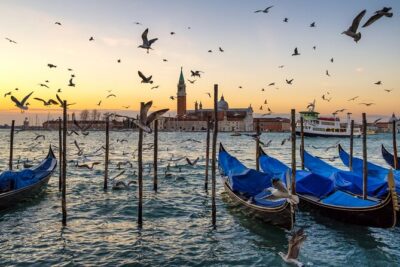 ★ 4.0Venice Private Gondola Ride: Explore Hidden Canals and SightsFrom $95334 reviews
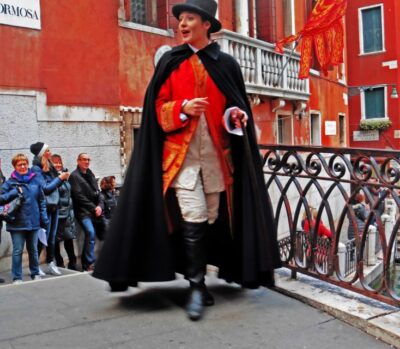 ★ 4.5Theatrical Walking Carnival Show & Casanova’s Secrets319 reviews
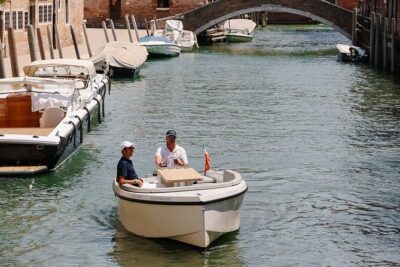 ★ 4.5The Hidden Canals on an Electric BoatFrom $120307 reviews
Browse the lists this tour appears in