
Review · HISTORICAL TOURS
Venice: Entrance Ticket to the Naval Historical Museum
Venice’s navy story is hiding in plain sight. The Naval Historical Museum (MUNAV) is a short walk from Piazza San Marco, and it turns Venice’s long maritime past into something you can actually read and see across five floors. I like the direct focus on ships and sea life, and I also like that the museum feels well-made and easy for all ages to follow. One thing to consider: this is just an entrance ticket, so there’s no guided tour included—meaning you’ll get the most out of it if you’re happy reading exhibit text and details.
MUNAV is owned by the Italian Navy and managed by the Ministry of Defense, so it has that serious, official care you want in a historical collection. The exhibits connect ancient Venetian craft to modern Italian Navy models, with an especially intriguing section featuring boats from China and the Far East. If you’re expecting an action-packed show, you’ll likely want to manage your expectations—this place is for looking, learning, and taking your time with objects.
In This Review
- Key Highlights You Should Care About
- Why MUNAV Works So Well Near San Marco
- The 15th-Century Building: More Than Just a Museum Box
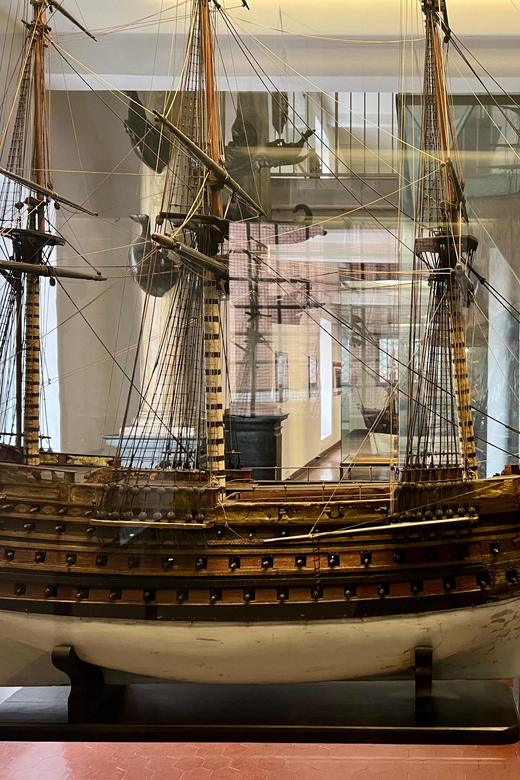
- What You’ll See: Boats, Models, Paintings, and Documents
- The “5 Floors in 1.5 Hours” Reality Check
- Skip the Line: Why the Entrance Detail Matters
- Price and Value: Is $18 Worth It?
- Who This Museum Suits Best (and Who Might Want Another Plan)
- Practical Tips for a Smooth Visit
- Should You Book the Venice Naval Historical Museum Ticket?
- FAQ
- How long does the visit take?
- What’s included with the ticket?
- Where is the Naval Historical Museum of Venice (MUNAV)?
- Do I need to join a guided tour?
- Can I skip the line?
- Is there a fee, and what does it cost?
- Are small pets allowed inside?
- What’s the cancellation policy?
- Can I reserve without paying right away?
Key Highlights You Should Care About
- A 15th-century granary building: You’re touring history literally housed in a former “Granary” of the Serenissima Republic.
- Five floors of maritime material: Plan for a real walk-through rather than a quick look at one room.
- Ship models, paintings, and documents: It’s not just boats—there are papers and artworks that explain context.
- Venice to the modern Italian Navy: The collection spans origins through today’s forces.
- Boats from China and the Far East: A standout variety you won’t find in every European maritime museum.
- Skip-the-line via a separate entrance: Your entry moves faster than the usual route.
Why MUNAV Works So Well Near San Marco
Piazza San Marco gets all the attention, but I love that MUNAV gives you a different Venice angle—water, ships, and the people behind them. The museum sits about a five-minute walk from Piazza San Marco, and it’s also adjacent to the Ancient Arsenal of Venice. That location matters because it places you in the same general neighborhood where Venice’s maritime power made sense.
The museum itself is run in an official military context: it’s owned by the Italian Navy and managed by the Ministry of Defense. That may sound formal, but it shows up in how the collection is presented—structured, labeled, and clearly meant to preserve knowledge.
I also appreciate how “for everyone” this experience can be. The layout and subject matter are understandable even if your background is casual. I found it especially good when you want a calm indoor stop that still feels connected to Venice’s real story.
Worth weighing up before you book this Venice outing:
- Venice: Doge’s Palace Reserved Entry Ticket★ 4.6 · 42,716 reviews
- Venice: La Fenice Opera House Entry Ticket with Audio Guide★ 4.6 · 11,742 reviews
- Venice: Leonardo Da Vinci Museum Entrance Ticket★ 4.5 · 3,560 reviews
- Venice: St. Mark’s Basilica & Doge’s Palace Tour with Ticket★ 4.7 · 3,375 reviews
The 15th-Century Building: More Than Just a Museum Box
MUNAV takes place in a 15th-century building that once served as the Granary of the Serenissima Republic. That kind of detail is worth noting because it changes the feel of your visit. You’re not just looking at old boats; you’re in an old Venice structure tied to how the city sustained itself.
The museum spans about 6,000 square meters and presents exhibits across five floors. In practical terms, this means you’ll want comfortable shoes and a bit of energy. Even though the ticket duration is listed as 1.5 hours, the building’s size and floor-to-floor layout can make you slow down if a certain exhibit catches your eye.
There’s also something satisfying about the Arsenal neighborhood setting. If you’re already walking near the Arsenal, this ticket makes your time feel more intentional. Instead of seeing only stones and facades, you get the maritime machinery—ships, plans, and the documentary side of naval life.
What You’ll See: Boats, Models, Paintings, and Documents
The core of the collection is maritime tradition, and the museum does a good job keeping that theme consistent. You’ll move through exhibits that cover ancient Venetian boats up to contemporary Italian Navy models. That sweep is one reason this museum feels more than a single-era curiosity.
Here’s what you can expect to encounter as you go:
- Historical artifacts and ship models that show how vessel design evolved.
- Paintings and documents, which help you connect ships to people, periods, and operations.
- A broad representation of Venice’s naval role, from origins to the modern era.
What I find helpful is that it’s not only “look at a boat and move on.” The inclusion of documents and paintings adds context. If you’re the kind of traveler who likes knowing why something mattered (not just that it existed), this museum supports that habit.
Then there’s the part that tends to grab attention fast: an exceptional collection of boats from China and the Far East. I’d treat that as a must-see within your visit because it adds global range to the Venice story. It also makes the museum feel less like a one-note local museum and more like a place showing wider maritime connections.
The “5 Floors in 1.5 Hours” Reality Check
The ticket lists a 1.5-hour duration, which is a useful planning anchor. Still, don’t treat it like a strict countdown where everything is designed to fit neatly. In museums like this, your pacing depends on what grabs you—especially ship models and document displays that invite closer reading.
I’d plan your visit like this:
- Start with the main maritime narrative first, so you understand the overall arc of the collection.
- Then spend extra time on the areas that match your interests, like the China/Far East boats section if you’re curious about cross-cultural maritime influences.
- Leave a little buffer to loop back if you realize you want more time with ship designs or drawings.
If you’re with kids or you like quick stops, 1.5 hours can work well if you keep moving steadily. If you’re a detail person, you might finish closer to the edge of that time—or slightly over—because it’s easy to get pulled toward model details and the document-heavy sections.
Skip the Line: Why the Entrance Detail Matters
One of the practical perks here is skip-the-line access through a separate entrance. Venice is famously unpredictable with crowds, and when you’re near a major hub like San Marco, every time-saving move helps.
What I like about this kind of entry arrangement is that it keeps the visit from feeling stressful. Instead of spending your arrival time scanning lines, you can get inside, orient yourself, and start learning right away. That makes a short museum stop feel more satisfying.
Also, if you’re pairing this with other sights nearby, fast entry helps you build a tighter plan. You can think of MUNAV as a high-value indoor add-on when your outdoor schedule is flexible but not endless.
Deeper into the old Republic





Price and Value: Is $18 Worth It?
At $18 per person, the museum isn’t cheap—but I think the value is fair if you want a focused maritime education in a real Venetian setting. You’re paying for:
- A curated collection across five floors
- A mix of ship models, paintings, and documents
- The credibility of an institution owned by the Italian Navy and run through the Ministry of Defense
If your goal is only a casual glance at one or two rooms, you might feel the cost. But if you enjoy reading placards, looking at technical shapes, and absorbing how maritime forces evolved, the time-to-learning ratio is strong.
The biggest value lever is the “total package” feel. Many small museums in Venice can be charming but limited. Here, the museum’s size and structured subject make it easier to justify the ticket, even on a shorter day.
Who This Museum Suits Best (and Who Might Want Another Plan)
MUNAV fits best when you like history that has objects. If you enjoy ship models, documents, and how designs changed over time, you’ll likely get more from every room.
It also suits a mixed group well. I found it easy to imagine it working for couples, families, and solo visitors because the subject is specific but not overly technical. Even if you’re not a naval expert, the visual side—boats and models—pulls you in quickly.
This is less ideal if you want:
- A guided, story-driven experience led by a live instructor (there’s no guided tour included)
- A performance-style attraction with constant action
If that’s you, consider pairing this visit with another activity that includes a guide, or simply plan to spend time reading. This museum rewards a slower, observant pace.
Practical Tips for a Smooth Visit
You can make MUNAV easier on yourself with a few common-sense moves. First: wear comfortable shoes. With five floors and multiple displays, you’ll be walking more than you might expect.
Second: set your expectations for reading. Since you’re there on an entry ticket without a guided tour, your best experience comes from your own curiosity—so skim the main labels, then focus on the details that catch your eye.
Third: treat the Arsenal-adjacent location as a signal. Before you go in, it helps to mentally connect Venice’s shipbuilding and maritime power to where you’re standing. Once you do that, the exhibits feel less like separate cases and more like one continuing story.
Finally: if you’re visiting with a small pet, plan ahead. Access to rooms and outdoor spaces is permitted with small pets if they are carried in their own carrier or in arms for the visit. Guide dogs for visually impaired visitors are exempt from that rule.
Should You Book the Venice Naval Historical Museum Ticket?
Yes, I’d book it if you want a strong indoor stop that connects directly to Venice’s real maritime identity. The $18 price feels reasonable for a museum of this size and scope, especially because you get skip-the-line entry and a collection that runs from ancient Venetian boats to modern Italian Navy models.
I’d especially recommend it if you like museums with objects—boats, models, paintings, and documents—and you want something that feels organized rather than random. If you prefer a guided narrative, you can still enjoy it, but plan to spend time reading and moving steadily between floors.
FAQ
How long does the visit take?
The experience is listed as 1.5 hours. It’s a good estimate for seeing the main areas, though your pace depends on how long you linger with exhibits.
What’s included with the ticket?
Your ticket includes entry only. A guided tour is not included.
Where is the Naval Historical Museum of Venice (MUNAV)?
MUNAV is in Venice, Veneto, Italy. It’s about a five-minute walk from Piazza San Marco and is adjacent to the Ancient Arsenal of Venice.
Do I need to join a guided tour?
No. The ticket is for admission, and guided tours are not included with this option.
Can I skip the line?
Yes. You get skip-the-line access through a separate entrance.
Is there a fee, and what does it cost?
The price listed is $18 per person.
Are small pets allowed inside?
Small pets are allowed if they are carried in their own carrier or in arms for the duration of the visit. Guide dogs for the visually impaired are exempt from this rule.
What’s the cancellation policy?
You can cancel up to 24 hours in advance for a full refund.
Can I reserve without paying right away?
Yes. The option includes Reserve & Pay Later, so you can book your spot and pay nothing today.
The Old Republic, Toured Properly
- Venice’s Best: Basilica, Doge’s Palace, Gondola & History Gallery
★ 4.5 · 2,478 reviews - Venice: City Center Historical Guided Walking Tour
★ 4.2 · 1,873 reviews - Venice: The History of St. Mark’s Basilica Tour
★ 4.2 · 986 reviews - Venice: Bell Tower & St Mark’s Square History Gallery Ticket
★ 4.3 · 910 reviews - Basilica, Doge’s Palace, History Gallery & Bell Tower Option
★ 5.0 · 586 reviews - Venice: Natural History Museum Entry Ticket
★ 4.7 · 312 reviews
More Tickets in Venice
- Venice: Doge’s Palace Reserved Entry Ticket
★ 4.6 · 42,716 reviews - Venice: La Fenice Opera House Entry Ticket with Audio Guide
★ 4.6 · 11,742 reviews - Venice: Leonardo Da Vinci Museum Entrance Ticket
★ 4.5 · 3,560 reviews - Venice: St. Mark’s Basilica & Doge’s Palace Tour with Ticket
★ 4.7 · 3,375 reviews - Venice: Palazzo Contarini del Bovolo Entrance Ticket
★ 4.3 · 1,991 reviews - Doge’s Palace & St. Mark’s Basilica Tickets + Tour Options
★ 4.5 · 1,841 reviews
More Tour Reviews in Venice
- Venice: Doge’s Palace Reserved Entry Ticket
★ 4.6 · 42,716 reviews - Venice: Grand Canal Gondola Ride with App Commentary
★ 4.1 · 23,020 reviews - Venice: Grand Canal Gondola Experience with Live Commentary™
★ 4.2 · 16,504 reviews - Boat Trip: Glimpse of Murano, Torcello & Burano Islands
★ 4.3 · 15,699 reviews - Venice: La Fenice Opera House Entry Ticket with Audio Guide
★ 4.6 · 11,742 reviews - Murano & Burano: Boat Tour with Guide & Glass Factory Visit
★ 4.3 · 10,716 reviews
Fresh Off the Vaporetto: New Venice Reviews






Historical Tours, compared.
 ★ 4.5Venice’s Best: Basilica, Doge’s Palace, Gondola & History GalleryFrom $1292,478 reviews
 ★ 4.2City Center Historical Guided Walking TourFrom $141,873 reviews
 ★ 4.2The History of St. Mark’s Basilica TourFrom $34986 reviews
 ★ 4.3Bell Tower & St Mark’s Square History Gallery TicketFrom $44910 reviews
 ★ 5.0Basilica, Doge’s Palace, History Gallery & Bell Tower OptionFrom $116586 reviews
 ★ 4.7Natural History Museum Entry TicketFrom $11312 reviews
 ★ 3.7Doge’s Palace Historic Mysteries Guided Tour238 reviews
 ★ 3.5St. Mark’s Cathedral Priority Guided Tour & History GalleryFrom $33148 reviews
Browse the lists this tour appears in